

How to Reconcile a Bank Statement for a Small Business (Our 2026 Month-End Playbook)
· TransactionFlow
When we fall behind on how to reconcile a bank statement for a small business, cash flow decisions get harder because we are effectively guessing what the bank actually paid or collected. In fact, 88% of small businesses report cash flow disruptions, which is why reconciling every statement matters in 2026.

Key Takeaways
| Goal | Match each bank transaction to our books, then explain any differences. |
| Best cadence in 2026 | Reconcile monthly, and do quick checks more often when transaction volume is high. |
| Top mismatch causes | Deposits in transit, outstanding checks, bank fees, reversals, timing differences. |
| What to document | Audit trail evidence, reference numbers, and the reason for every adjustment. |
| Tooling option | Automation with a bank reconciliation workflow and audit trails can reduce manual matching. |
| Start here | Use our process below, or review how to do bank reconciliation for the baseline mechanics. |
- Reconcile by transaction, not by totals. Totals help, but the work is matching and explaining differences.
- Use the bank statement period as the truth. Our ledger entries must be mapped to the same timeframe.
- Build a repeatable checklist. We reduce missed items by following the same order every month.
- Track timing differences. Deposits in transit and outstanding checks are common in 2026.
- Document every adjustment. Our evidence-backed reconciliation trail matters for audits and disputes.
- Consider automation when volume is high. TransactionFlow includes automated matching and audit trail support (see bank reconciliation features).
- What is bank reconciliation, and why does it matter for our small business? It’s the process of comparing what the bank shows versus our books and resolving differences. (If you need a quick definition, see what is bank reconciliation.)
- How often should we reconcile our account? For most small businesses, monthly reconciliation plus targeted checks during heavy activity keeps us current in 2026.
- Why don’t our totals match the bank? Timing, bank fees, reversals, and data entry errors are the usual causes.
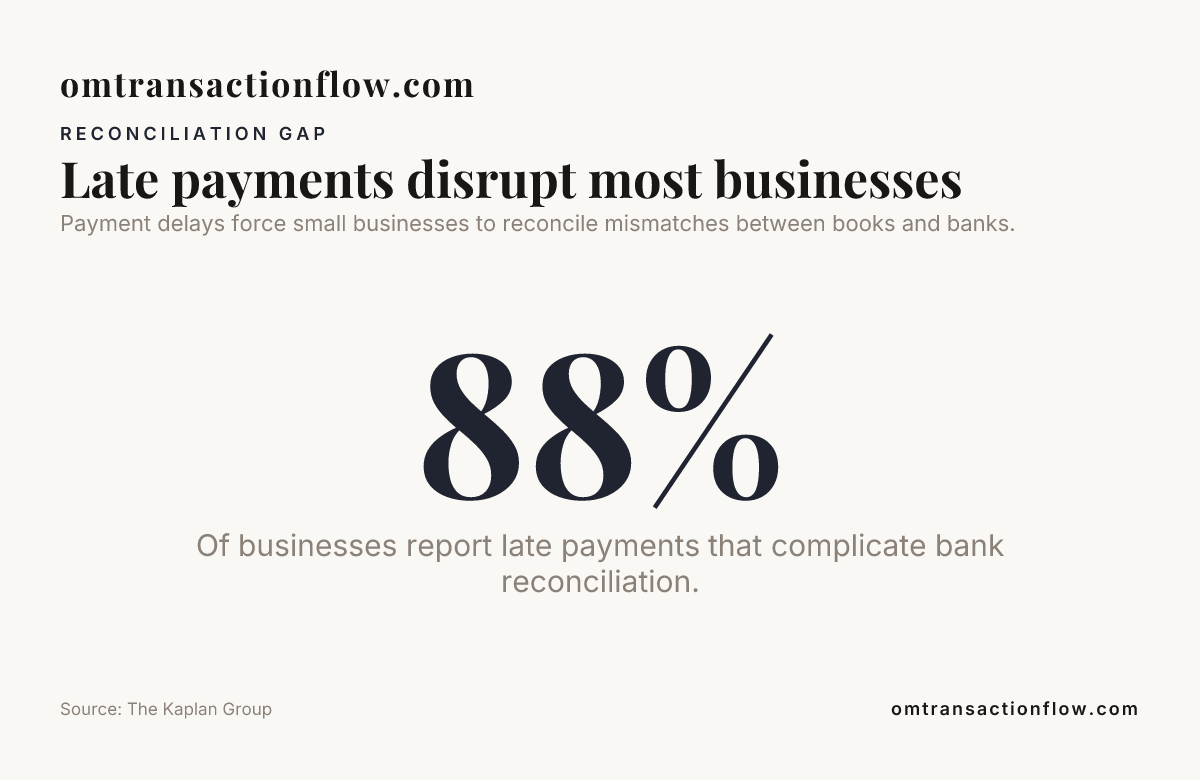
Payment delays force small businesses to reconcile mismatches between books and banks.
Step 1: Gather the documents we need (and set a clean reconciliation scope)
Before we reconcile, we set boundaries so our how to reconcile a bank statement for a small business process does not sprawl. In 2026, we typically reconcile one bank account per pass (checking first), then repeat for savings or merchant accounts if we track them separately.
Here is our “start line” checklist:
- Bank statement for the month (PDF or downloadable CSV).
- Our general ledger (or accounting software export) for the same date range.
- Sales and billing detail for deposits (invoices, batch deposit reports, payment processor summaries).
- Expense detail for card charges and vendor payments (bills, receipts, payroll reports).
- Bank fee and interest notes (monthly service fees, chargebacks, interest income, overdraft corrections).
We also decide what we will do with “unknown” items. For example, if a bank transaction has no matching invoice reference, we either:
- mark it as needs review, then resolve before closing the month, or
- create a temporary clearing category, then reclassify once documentation is found.
Tip: If our accounting period dates do not perfectly align with the bank statement dates, we reconcile using the bank statement’s transaction dates and adjust our books accordingly.
Step 2: Compare transactions line-by-line, not just ending balances
When we work on how to reconcile a bank statement for a small business, the fastest way to find errors is line-by-line matching. Totals are useful only after we have accounted for every transaction that moved cash.
Our method is simple:
- Export or view every transaction from the bank statement for the month.
- Create a matching worksheet (spreadsheet or reconciliation report).
- For each bank line, find the matching ledger entry by amount, date, and reference.
We keep an eye on the transaction types that usually cause mismatches:
- Deposits that land after a customer paid (timing difference).
- Outstanding checks written in one month but cleared in the next.
- Bank fees that we booked later (or not at all).
- Reversals and corrected transactions (especially around chargebacks and refunds).
- ACH transfers between accounts that may not exist in our books yet.
As we match, we update our reconciliation status:
- Matched (confirmed ledger + matching bank line)
- Matched with adjustment (ledger needs a reclass or memo fix)
- Unmatched (document and investigate)
If you want a second viewpoint on common reconciliation pitfalls, we often compare our workflow to guidance like bank reconciliation tips for your small business.

Step 3: Explain the differences (timing items, bank-only items, and book-only items)
In most months, how to reconcile a bank statement for a small business is really about explaining differences clearly. We do not “force” the numbers; we categorize the why.
Here is how we break differences down:
- Timing differences (both sides will eventually agree)
- Deposits in transit, customer payments that recorded in our books but are not yet on the bank statement.
- Outstanding checks, payments we issued but the bank has not cleared yet.
- Bank-only items (the bank records them before we do)
- service charges, ATM fees, interest income
- wire or ACH fees, returned items, chargebacks
- Book-only items (we recorded, but the bank line is different or missing)
- journal entries entered with the wrong date or reference
- duplicate entries, missing reversals, or incorrect amounts
Step 4: Make the right adjustments to the right side (books vs. bank reconciliation)
Once we understand the difference type, we adjust with discipline. This is core how to reconcile a bank statement for a small business skill, because the wrong adjustment can create a “match” that is actually incorrect.
We apply adjustments based on where the error lives:
- Adjust the books when the bank shows a transaction we did not record (for example, a monthly bank fee).
- Adjust a clearing entry when we recorded something to a clearing account but need it reclassified.
- Leave timing items alone when checks or deposits are legitimately outstanding. We carry them forward to the next reconciliation cycle.
- Correct ledger entry errors when the amount or date is wrong.
To keep our process consistent in 2026, we also document each adjustment with a short note:
- what the bank line said (date, amount, description)
- what our books had recorded
- the reason for the change
- the supporting document (invoice, receipt, fee notice)
If we need a tool for automated classification and matching, platforms built around bank reconciliation workflows can reduce manual effort. For example, TransactionFlow’s pricing page describes plan options that include automation and audit trails (see TransactionFlow pricing), which we use as a reference point when deciding whether to automate.

Step 5: Use automation wisely when volume is high (and keep an audit trail)
Automation helps when our transaction volume makes line-by-line matching too time-consuming. When we implement how to reconcile a bank statement for a small business workflow using software, we still run review checks, we do not trust matches blindly.
Our priority criteria for automation in 2026:
- Automated transaction classification and reconciliation (so matches are suggested, not guessed).
- Audit trail evidence so we can prove why a transaction was categorized and matched.
- Ability to trace source items back to bank statements and invoices.
- Bank feeds and invoice connectivity to reduce copy-paste errors.
TransactionFlow describes “bank reconciliation automation” that auto-matches bank transactions to ledger entries and creates an audit trail across reconciliations. Their features page also emphasizes matching tied to source items and audit trail support (see TransactionFlow features).
Note: Some pages we reviewed list features and pricing but do not include product images, so we rely on feature descriptions rather than graphics when selecting tools.
Step 6: Build a monthly reconciliation checklist we can reuse
A reusable checklist turns how to reconcile a bank statement for a small business into a predictable month-end routine. In 2026, that predictability matters because it reduces last-minute scramble and missed items.
Here is our practical month-end checklist:
- Download the bank statement for the month and export transactions.
- Verify opening balance ties to the prior reconciliation ending balance.
- Match deposits to invoices and payment batch records.
- Match withdrawals to bills, vendor payments, payroll, and card charges.
- Record bank-only items (fees, interest, reversals) in our books.
- List timing differences (deposits in transit, outstanding checks) for carryforward.
- Re-run totals and confirm the reconciliation balances.
- Review audit trail notes so we can explain any adjustments.
When we want additional context for common pitfalls, we use resources like how to reconcile a business bank account as a cross-check against our checklist. It helps us compare what we might overlook, such as miscategorized transactions and incomplete reference details.
Step 7: Reconcile multiple accounts and streamline integrations where possible
Many small businesses in 2026 handle more than one cash stream, like checking accounts, savings, and merchant deposits. When we expand how to reconcile a bank statement for a small business beyond a single account, we make sure each account has its own reconciliation scope.
Our approach:
- Reconcile one account at a time and finish it before moving on.
- Separate merchant deposits from operating deposits so refunds and chargebacks are easy to trace.
- Align references (invoice numbers, vendor IDs, payment batch IDs) so matching stays reliable.
For businesses that want a more connected workflow, TransactionFlow notes support for bank feeds and invoices, plus a bank reconciliation module and audit trail features. On their solutions page, they describe a workflow designed to keep books moving and streamline month-end close with evidence-based reconciliations (see TransactionFlow solutions).
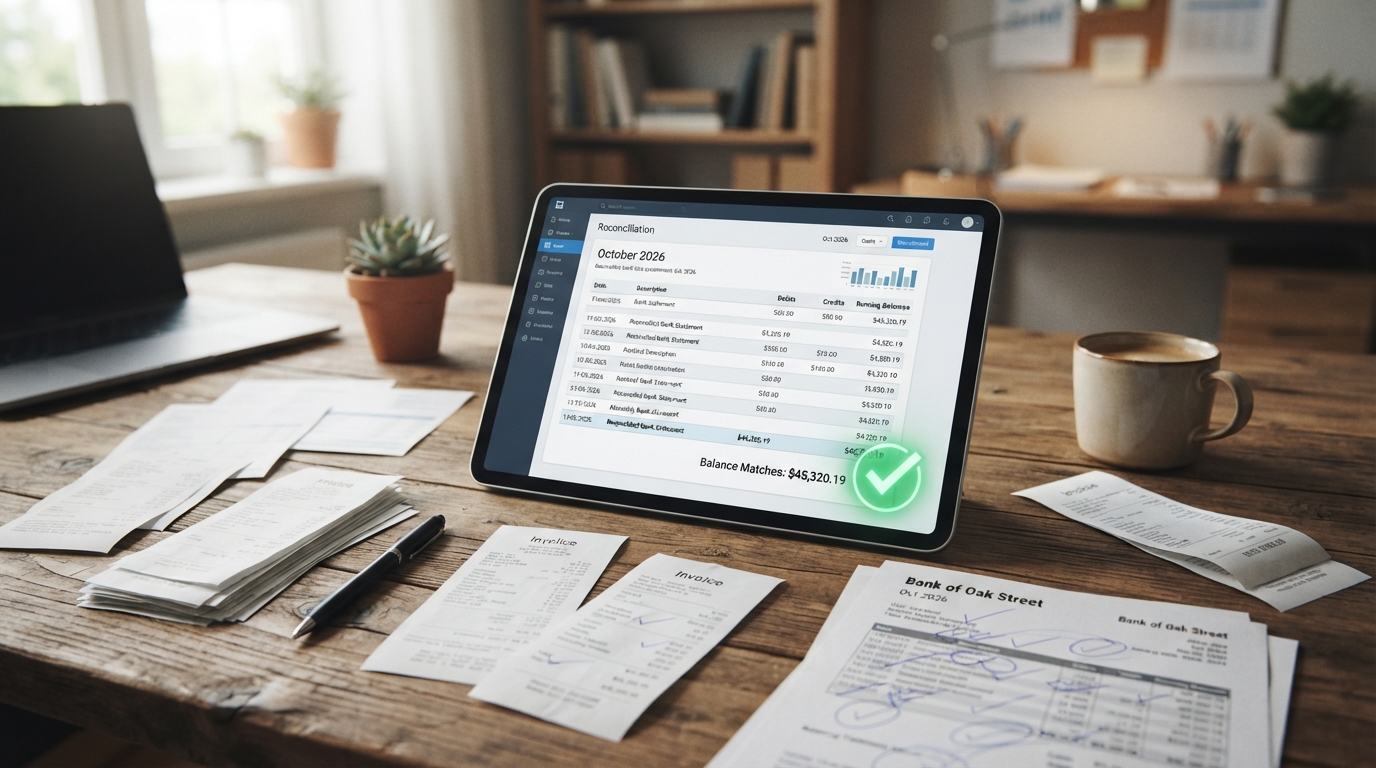
Conclusion: Our 2026-ready way to reconcile a bank statement for a small business
Learning how to reconcile a bank statement for a small business comes down to one principle: we match every bank transaction to our books and then explain every difference. In 2026, we focus on line-by-line reconciliation, clear categories for timing and bank-only items, and documentation for every adjustment.
If we keep our workflow consistent, use evidence-backed reconciliation notes, and consider automation when volume is high, our books stay aligned with real cash movement. That is how we reconcile confidently, month after month.
Frequently Asked Questions
How do I reconcile a bank statement for my small business if the dates don’t match my accounting period?
For how to reconcile a bank statement for a small business, use the bank statement transaction dates as the starting point, then adjust our books to reflect the same timing. We document timing differences like deposits in transit and outstanding checks so the reconciliation remains accurate and repeatable in 2026.
What are the most common reasons my bank reconciliation won’t balance?
The most common issues for how to reconcile a bank statement for a small business are bank fees or interest recorded late, timing differences (outstanding checks or deposits in transit), duplicate entries, and reversals not captured in our ledger. We fix each category systematically instead of guessing by totals.
Should I adjust the books or the reconciliation when I find a mismatch?
In a proper how to reconcile a bank statement for a small business workflow, we adjust the books when the bank shows something we did not record, and we carry forward legitimate timing items without forcing them to match immediately. For ledger errors, we correct the entry so future reconciliations are cleaner.
Can automation help with how to reconcile a bank statement for a small business in 2026?
Yes, automation can help when it provides transaction classification, auto-matching, and an audit trail. For example, TransactionFlow describes bank reconciliation automation that matches transactions to ledger entries while supporting evidence-backed audit trails, which can reduce manual work while keeping reviews in place.
How often should a small business reconcile bank statements?
Most small businesses reconcile monthly, then do quick checks more often when transaction volume is high, especially in 2026. The goal in how to reconcile a bank statement for a small business is to prevent mismatches from accumulating until month-end.
What should I include in my reconciliation notes for audit readiness?
For how to reconcile a bank statement for a small business, include the bank transaction date and amount, what our books originally recorded, the reason for any change, and the supporting document (invoice, receipt, or fee notice). This creates a clear audit trail that supports why each adjustment happened.
How do I reconcile multiple accounts, like checking and a merchant account, without double-counting?
We reconcile one account at a time and keep separate reference mappings for merchant deposits and refunds. In our how to reconcile a bank statement for a small business process, we prevent double-counting by ensuring each cash stream uses its own matching logic and reconciliation worksheet.